In This Guide
Oman is one of the most romantic honeymoon destinations in the Middle East — private, safe, and dramatically beautiful. Top honeymoon experiences: Wadi Shab hidden waterfall cave, Wahiba Sands desert stargazing overnight, Jebel Akhdar rose gardens at 2,000 metres, and Muscat harbour sunset. Private honeymoon tour from OMR 120/vehicle/day (~$312 USD).
Oman honeymoon planning works best when you stop thinking of it as a beach holiday with a romantic filter applied, and start thinking of it as a genuinely rare kind of trip — one where the landscape itself does the work. Couples who arrive expecting a polished resort corridor find something more interesting: wadis you swim into alone, mountain ridges cool enough for a jacket at dusk, desert nights where the silence is audible. This guide covers everything you need to plan a remarkable honeymoon in Oman in 2026, from the right hotels and itineraries to honest advice on budget, timing, and what most travel sites get quietly wrong.

Oman offers honeymoon couples something most popular destinations cannot: genuine seclusion without the price tag of a private island, across landscapes that shift from mountain to desert to coast within a single day's drive. The country is safe, exceptionally well-organised for international visitors, and populated by people who treat guests with a warmth that never feels performative. If your honeymoon needs to be both beautiful and effortless, Oman is one of the most consistently reliable choices in the region.

Oman receives a fraction of the tourists that neighbouring Dubai or Abu Dhabi attract, and that arithmetic matters enormously on a honeymoon. A wadi that might be crowded in another country is often empty here. A mountain viewpoint that would have a selfie queue elsewhere gives you ten minutes of unbroken quiet. That feeling of having a landscape to yourselves is not engineered — it is simply a consequence of Oman not yet being overrun, and it creates an intimacy that no resort amenity can fully replicate.
The exclusivity extends to how the country positions itself. Oman has deliberately avoided the mass-market tourism model. The result is a destination where even mid-range experiences feel considered and unhurried. Couples are not competing for sunbeds, not navigating theme-park queues, not sharing a sunset with three hundred other guests. That breathing room is precisely what honeymooners are paying for — and in Oman, it is built into the destination itself rather than costing extra.
The variety of Oman's landscape within a relatively compact geography is startling to first-time visitors. Within two hours of Muscat, you can be swimming in turquoise wadi pools framed by limestone cliffs, or sitting at 2,000 metres elevation watching cloud shadows move across a canyon wider than anything in the Alps. The Wahiba Sands shift colour through the day from gold to copper to a deep amber that makes every photograph look filtered. None of this requires a tour guide to appreciate — it simply asks you to be present and to move slowly.
The coastline deserves particular attention. Unlike the artificial beach developments further up the Gulf, Oman's shores are largely intact. The stretch between Muscat and Sur includes beaches where turtles nest, fishing villages that look much as they did a generation ago, and water so clear that snorkelling from a charter boat feels like dropping into an aquarium. For couples who find their most romantic moments in natural settings rather than hotel rooms, Oman delivers a sustained level of beauty that is genuinely hard to exhaust in a week.
For couples visiting the Middle East for the first time, safety is a real and reasonable concern that does not need to be dismissed or minimised. Oman consistently ranks as one of the safest countries in the region for international visitors. Street harassment is extremely rare. Navigation is straightforward — roads are well-marked, Google Maps works reliably, and driving between destinations is one of the pleasures of the trip rather than a source of anxiety. You can arrive as complete strangers to the country and feel settled within a day.
The infrastructure for international couples is quietly excellent. International credit cards are accepted at all hotels and most restaurants. English is widely spoken in tourism contexts. The visa process for most nationalities, including Indian passport holders, is now handled online with fast approval. There are no mandatory dress codes at resorts or beaches. The combination of natural grandeur and logistical simplicity makes Oman an ideal first international honeymoon — or a thoughtful return trip for couples who have already done the Maldives and want something with more texture.

The approach to Wadi Shab is part of the experience — a short boat crossing, then a forty-minute walk along a path that winds between date palms and emerald pools. Most couples manage the walk without difficulty, but the real moment comes when you swim through a narrow canyon passage and emerge inside a cave where a waterfall drops into a shallow pool lit by filtered light from above. It is entirely natural, completely quiet, and the kind of place that earns its reputation without any exaggeration. Plan to arrive before 9:00 AM to have the inner cave largely to yourselves. Bring water shoes, a dry bag for your phone, and nothing that cannot get wet.
The wadi rewards a full day rather than a rushed half-day visit. After the cave swim, find a flat rock near one of the outer pools and simply stop. The pools range from ankle-deep to several metres, and the water temperature in winter months sits at a refreshing cool rather than cold. Our Wadi Shab day trip includes private transport from Muscat, a guide for the walk, and enough time to do the experience properly rather than racing back for a hotel dinner. This is consistently one of the moments honeymooners tell me they remember most clearly, months and years later.
Sleeping in the Wahiba Sands is not the same as a desert resort experience in Dubai. The camps here are simpler, the dunes are larger, and the distance from city light pollution is enough that the Milky Way becomes visible most clear nights between October and April. A private camp arrangement — your own tent or cabin rather than a shared camp — costs more but transforms the experience entirely. Waking up to silence, stepping outside to watch the light change across dunes that stretch to the horizon, and having coffee brought to a mat set outside your tent: this is the version worth paying for.
The practical logistics are manageable. The drive from Muscat takes approximately three hours, or two from Nizwa. A 4WD vehicle is essential once you leave the main road, and almost all reputable camps provide transport from a designated meeting point. The best camps include a Bedouin-style dinner served on floor cushions under a canopy, camel riding at sunrise, and sandboarding for couples who want more activity. The temperature drops sharply after sunset between November and February, which — counter-intuitively — makes it better for honeymooners: a shared blanket, a clear sky, and a fire are a more honest kind of romance than anything a resort decorator could arrange.
Jebel Akhdar, the Green Mountain, sits at around 2,000 metres and has a climate completely unlike the coast. In winter months the evenings dip below 10°C, and the air smells of rose water and juniper rather than salt and diesel. The plateau villages of Saiq and Ash Sharayjah are known for their rose cultivation — Damask roses harvested each spring for distillation into rose water that Oman has been producing for centuries. Visiting during the brief harvest season in late March and early April adds a specific, beautiful layer to a honeymoon that no other destination in the region can offer.
The luxury lodges on Jebel Akhdar have invested heavily in the canyon experience. Balconies hang over a drop of several hundred metres. Infinity pools align with the ridge so that the water appears to fall into the valley below. The evenings are quiet enough that you can hear the wind in the terraced gardens below the hotel walls. Even for couples who normally prefer beach destinations, the mountains of Oman tend to produce the strongest emotional responses — there is something about the scale and the silence that makes conversation different, slower, better.
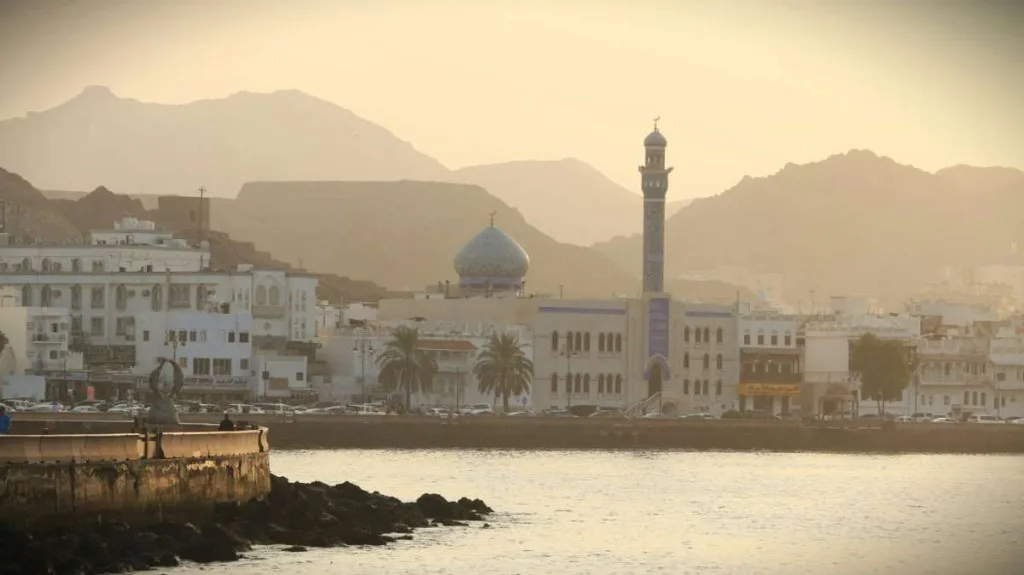
The Mutrah Corniche in Muscat is a two-kilometre waterfront promenade along the old harbour, backed by the walls of Mutrah Fort and fronted by working dhows still used for trade with East Africa and India. The morning hours bring vendors and delivery traffic. The hour before sunset brings something different: warm light across the water, the silhouettes of the mountains behind the port turning violet, and a pace of life that slows perceptibly as the city's working day ends. Arrive around 5:00 PM between October and March and walk from the fort end toward the fish market slowly. Stop at the old Omani coffee houses for kahwa and halwa before dinner.
What makes the Corniche work as a romantic evening is precisely what it is not. It is not staged. The lights reflecting on the water are the lights of a real harbour. The boats anchored offshore are working vessels. The families out for their evening walk are not there for tourism — they are there because it is their neighbourhood. This authenticity is harder to find than it sounds, and couples who travel widely tend to recognise and value it. After the walk, dinner at one of the upper-floor restaurants overlooking the harbour completes an evening that costs almost nothing and stays long in memory.
The Daymaniyat Islands lie about 18 kilometres off the coast northwest of Muscat, within a protected nature reserve, and the water around them holds some of the best snorkelling in the Arabian Sea. Visibility can reach 15 to 20 metres on a calm day. Turtles are common and largely unbothered by swimmers. The coral formations are intact in a way that is increasingly rare. A private charter — your own boat and captain, not a shared tour — makes the difference between a genuinely private experience and a group outing. Allow a full day and brief the captain in advance that you want unhurried stops rather than a rushed circuit.
Private half-day charters from the Seeb Marina area typically cost between OMR 80 and OMR 150 (approximately USD 208 to USD 390), depending on boat size and duration. Full-day private charters with lunch provided run approximately OMR 150 to OMR 220 (approximately USD 390 to USD 572). These prices are negotiable through a reputable operator and are far better value than equivalent private charter experiences in the Maldives or Thailand. The islands are closed to visitors between May and September to protect nesting seabirds, so plan this experience between October and April. Bring reef-safe sunscreen — the reserve guidelines prohibit chemical sunscreens, and enforcement has increased.
Amouage is not a gift shop stop. It is one of the world's most serious luxury perfume houses, founded in Muscat in 1983 with a mandate to create fragrances of extraordinary richness using Omani frankincense, rose, and myrrh as foundations. The factory and showroom on the outskirts of Muscat offers tours that walk through the production process, from raw ingredients to finished bottle. For couples who enjoy the sensory dimensions of travel, sitting together in a fragrance consultation room — where a trained advisor helps you identify the notes that resonate with both of you — is an unexpectedly absorbing and intimate activity.
The act of choosing a shared fragrance as a couple is genuinely romantic in the way that few scheduled activities manage to be. It requires you to articulate preferences, disagree gently, reach a conclusion together. Many couples who visit Amouage on honeymoon return home with a scent that becomes specifically associated with the trip — a more useful and more evocative souvenir than anything wrapped in a box. Amouage fragrances are not inexpensive; bottles start at approximately OMR 60 (USD 156) and the signature collection runs considerably higher. But the factory visit itself is free, and even browsing the lineup is an hour well spent in an air-conditioned, beautifully designed space.

The Chedi is the reference point for luxury accommodation in Muscat, and it earns that position consistently rather than on reputation alone. The long pool — one of the longest hotel pools in the Middle East — runs parallel to the beach, and the design maintains a hushed, monastic elegance that makes it feel more like a private estate than a hotel. The beach access is private, the spa is exceptional, and the multiple restaurants offer enough variety for a several-night stay without repetition. The Long Bar is one of the most civilised places in Muscat for a pre-dinner drink. Room rates for a superior room typically run between OMR 120 and OMR 200 per night (approximately USD 312 to USD 520) depending on season and room category.
For honeymooners specifically, the Chedi offers dedicated packages that include champagne on arrival, early check-in, and complimentary room upgrades when available — worth requesting explicitly when booking rather than hoping it happens automatically. The beach villas with private plunge pools represent the best value upgrade if the budget permits, sitting at approximately OMR 280 to OMR 380 per night (USD 728 to USD 988). The hotel's location in the Al Ghubra area puts it close to the Sultan Qaboos Grand Mosque and a short drive from Mutrah, making it a practical base for couples who want both luxury comfort and genuine cultural access.
Alila Hinu Bay sits on the southern coast near Mirbat in the Dhofar region, a clifftop property above a private beach that is genuinely remote by almost any standard. The nearest town is a forty-minute drive. There is no reason to leave unless you actively want to, which for a certain type of honeymoon is exactly right. The infinity pool hangs over the ocean. The suites are large and face the water. The beach below the property is private in practice even when not technically exclusive, simply because nobody else is near enough to share it.
The Dhofar region has a microclimate unlike the rest of Oman, and Salalah — the regional capital — turns dramatically green during the Khareef monsoon season between July and September. Alila Hinu Bay is at its most spectacular during this period, when the cliffs are carpeted and the ocean mist creates a completely different atmosphere from the golden-dry landscape familiar from Muscat-region photography. Rates at Alila Hinu Bay typically start at OMR 180 per night (approximately USD 468) for a sea-view room, with the premium pool suites running to OMR 350 and above (USD 910). It requires a flight from Muscat to Salalah — approximately one hour — but the distance is part of what makes it feel genuinely removed from ordinary life.
Anantara Al Jabal Al Akhdar sits at 2,000 metres on the edge of a canyon and holds the claim of being one of the highest five-star resorts in the world. The canyon views from the infinity pool and the cliff-edge terrace are not the kind of views you can replicate anywhere else in the region. Evenings cool enough for a fireplace and a shared blanket on the terrace, combined with a level of service that manages to be attentive without being intrusive, make this the most consistently praised luxury option I recommend to honeymoon couples seeking mountains over beaches.
The rose petal bath experience — part of the hotel's honeymoon package — sounds like marketing until you experience the actual geometry of the room and the balcony, where the bath sits adjacent to a full-length window overlooking the canyon. It converts. Rooms start at approximately OMR 150 per night (USD 390) for a canyon-view deluxe room, with the canyon pool villas running to OMR 400 and beyond (USD 1,040). The hotel also runs guided heritage walks into the ancient village terraces, frankincense distillery visits, and rose garden tours in season — all of which add cultural substance to what could otherwise be purely a luxury bubble experience.
The quality of desert camps in Wahiba Sands varies considerably, and choosing well matters enormously. For honeymoon couples, the priority is a private or semi-private arrangement — your own tent rather than a shared camp dormitory setting. The better camps, including 1000 Nights Camp and Desert Night Camp, offer individual luxury tents with private bathrooms, proper beds, and enough distance between units that you genuinely feel alone in the desert. Rates for a luxury tent with dinner and breakfast included typically run between OMR 70 and OMR 120 per couple per night (approximately USD 182 to USD 312).
The included activities at reputable camps — camel rides, dune driving, guided sunset walks — are all worth accepting as offered rather than treating as optional extras. The Bedouin dinner served on floor cushions under an open-sided tent, with a fire and the dunes as backdrop, is the kind of meal where the setting matters more than the food, and the camps that do this well understand the balance between atmosphere and quality. Book directly or through a specialist operator rather than third-party booking platforms, which often list camps without distinguishing between the well-run private experiences and the large group operations that share the same desert postcode.
Six Senses Zighy Bay is not straightforward to reach, and that is the point. The resort sits in a bay on the Musandam peninsula — Oman's geographic exclave separated from the main country by a strip of UAE territory — accessible either by speedboat across the fjord, by a mountain road that drops steeply into the bay, or, most memorably, by tandem paraglide from the ridge above. The paraglide arrival is elective and genuinely wonderful; the resort arranges it for guests who want to begin the stay with something they will describe for years. The fjords of Musandam are often compared to Norway's, and the comparison holds — dramatic rocky walls descending into dark, still water.
The resort is built in a style that references traditional Omani village architecture, with individual pool villas spread across the hillside. Each villa has a private plunge pool and direct access to the beach. Snorkelling and kayaking in the fjord are included. Dhow cruises into the narrow passages of the fjord, with dolphins common in the early mornings, are bookable through the resort. Room rates begin at approximately OMR 250 per night (USD 650) and rise to OMR 600 and above (USD 1,560) for the larger beach villas. This is among the most expensive options in Oman, but it is also the most geographically singular — there is genuinely nothing else like the Musandam fjords in the region.

Day one is Muscat: arrive, check into the Chedi or a comparable hotel, and spend the afternoon recovering from travel near the pool. Day two: Sultan Qaboos Grand Mosque early morning (before 9:00 AM), Mutrah souq in the late morning, and the Corniche at sunset — unhurried, with coffee stops built in. Day three: drive to Jebel Akhdar (approximately 2.5 hours), check into Anantara Al Jabal Al Akhdar, afternoon walk along the canyon rim before dinner with the valley lights below. Day four: rose village walk in the morning, afternoon at leisure at the hotel. Day five: return to Muscat for a final evening and late-night flight, or extend into day six for a Wadi Shab day trip on the return journey.
This itinerary works for couples who want cultural depth and natural beauty without the complexity of multiple domestic transfers. It is entirely driveable in a standard hire car except for the final stretch to Jebel Akhdar, which requires a 4WD — available to rent from Muscat for approximately OMR 35 to OMR 55 per day (USD 91 to USD 143). For couples who prefer not to drive, our Oman private tour packages handle all logistics with a private driver who understands honeymoon pacing — no rush, no group, no compromises on timing.
The seven-day version adds the desert and the east coast to the mountain and city base. Days one and two cover Muscat and the Corniche. Day three includes a Wadi Shab day trip. Day four drives through Nizwa — a brief stop for the fort and the frankincense market — continuing to Wahiba Sands for a desert overnight. Day five: sunrise on the dunes, late morning return drive to Sur, afternoon at the turtle beach at Ras Al Jinz if timing and permits align. Day six: Jebel Akhdar. Day seven: return to Muscat.
This circuit covers Oman's four most distinct landscapes — city, wadi, desert, mountain — without feeling rushed if you keep driving days to manageable distances and resist the temptation to add extra stops. The overnight at Wahiba Sands is the emotional centrepiece of the week for most couples. Nizwa on a Friday morning, when the weekly cattle market runs alongside the souq, adds an unexpected and entirely unfiltered Omani scene that is nothing like a tourist site. Allow ninety minutes there rather than thirty, and follow the smell of frankincense into the covered market section rather than staying with the fort crowds.
Ten days allows you to add either Salalah in the south or Musandam in the north to the central circuit — two destinations that are fundamentally different from each other and from anything else in the country. Salalah makes most sense between July and September during the Khareef monsoon, when the landscape turns green and misty and the temperature is a remarkable 25°C while the rest of Oman bakes. Outside that window, Salalah is still worth visiting for its frankincense trees, the beach at Mughsail, and the blowholes — but the Khareef transforms it. A flight from Muscat to Salalah and back costs between OMR 25 and OMR 60 per person (approximately USD 65 to USD 156) depending on advance booking.
Musandam as the extension suits couples travelling outside the monsoon window — the fjord scenery is at its most dramatic between October and March when the light is clear and dhow cruising conditions are ideal. Six Senses Zighy Bay works as a two or three night finale to a honeymoon, arriving by the paraglide if the budget allows and departing by boat to the Dibba ferry point for a short transfer back to Dubai or Muscat. The ten-day circuit requires slightly more logistical planning but delivers a breadth of experience that genuinely earns the label of a journey rather than simply a holiday — which is exactly the quality that makes an Oman honeymoon memorable long after the photographs fade.

The four months between November and February represent Oman at its most comfortable and most beautiful for international couples. Daytime temperatures in Muscat sit between 22°C and 28°C — warm enough for beach and wadi activities, cool enough that walking through a souq or a mountain village in the afternoon does not require a retreat to air conditioning. The desert nights in Wahiba Sands drop to 12°C or below, making the fire and shared blanket combination genuinely necessary rather than staged. Mountain mornings on Jebel Akhdar can be cold enough to see your breath. The quality of light in winter months — clear, golden, with low sun angles that photographers plan trips around — makes the landscape more photogenic than at any other time of year.
The trade-off is that this is Oman's peak tourism season, and the better hotels book up early. The Chedi Muscat and Anantara Al Jabal Al Akhdar can be fully committed for weekends and holiday periods (particularly Christmas, New Year, and Indian national holidays) as much as four to six months in advance. Book accommodation for November to February before you book flights, not the other way around. For detailed season-by-season analysis, including rainfall data and specific event calendars, our guide to the best time to visit Oman covers the full picture.
March and April offer a different but genuinely excellent honeymoon window that many couples overlook. The temperatures are still manageable — typically 28°C to 34°C in Muscat — and the Jebel Akhdar rose harvest runs from late March into mid-April, filling the mountain villages with a fragrance and a visual spectacle that is entirely unique to this period. The rose harvest is not a tourist event; it is a working agricultural activity that happens to be extraordinarily beautiful, and couples who walk through the village gardens at this time encounter something that cannot be scheduled into any other season.
Hotel rates in March and April are typically 20 to 35 percent lower than peak December and January pricing. The wadis are running with water from any winter rains, the desert is not yet hot, and the crowds — never large by global standards — thin further. April does see a gradual temperature rise that makes midday outdoor activities uncomfortable in lower elevations, but morning wadi swims and mountain stays remain perfectly pleasant throughout the month. For couples sensitive to budget who still want a high-quality experience, the March to April window is the most undervalued period in the Oman honeymoon calendar.
June through September in Muscat and the central regions is not a honeymoon window. Temperatures regularly exceed 40°C with humidity that makes outdoor activity at any time other than early morning genuinely unpleasant. The wadis can be dangerously prone to flash flooding during summer storms. Several outdoor attractions close or operate reduced hours. Honest advice: do not plan a honeymoon in Muscat or Jebel Akhdar or Wahiba Sands between June and September, regardless of the hotel discounts available. The experience will not be what you planned, and the savings will not compensate for what is lost.
The singular exception is Salalah, where the Indian Ocean monsoon — the Khareef — arrives between July and mid-September and transforms the Dhofar region into a green, mist-draped landscape that bears no resemblance to summer Oman anywhere else. Temperatures in Salalah during Khareef sit at a remarkable 23°C to 27°C. The waterfalls run, the mountains are vivid green, and the atmosphere is genuinely romantic in a lush, unusual way. If your wedding falls in summer and Oman is where you want to honeymoon, book Salalah and Alila Hinu Bay rather than Muscat, and treat


A luxury Oman honeymoon with The Chedi or Anantara, a private driver, and one desert overnight typically lands around OMR 400–700 (USD 1,040–1,820) per couple per day in peak winter. That usually includes a premium room or suite, breakfast, and a dedicated vehicle — dinners, spa, and champagne moments sit on top.
The number that surprises couples is not the hotel rate; it is how quickly private experiences add up when you book them à la carte. Lock transport and key day trips into one package and you spend less time comparing WhatsApp quotes and more time on the canyon terrace.
A beautiful mid-range honeymoon is realistic at about OMR 150–250 (USD 390–650) per couple per day with good 4-star hotels, a private driver for touring days, and one upgraded desert camp night. You will not get every rose-petal bath ritual, but you will still get Wadi Shab, Mutrah sunsets, and stars over Wahiba.
Choose one splurge night — Anantara or a top desert camp — and keep Muscat nights simpler. That single contrast often feels more romantic than seven identical luxury nights.
Splurge on the mountain or desert night, the private driver on long transfer days, and one private boat or picnic setup. Those are the memories couples describe a year later. Save on lunch (simple local restaurants are excellent), souvenirs, and packing five evening outfits you will never wear.
Do not cheap out on water shoes or sun protection to protect a hotel budget. Nothing kills romance faster than blistered feet halfway to the waterfall cave.
In Muscat hotels and resorts, smart casual is fine. In souqs, forts, and residential areas, cover shoulders and knees — not out of fear, out of courtesy that keeps interactions warm. Swimwear belongs at hotel pools and beaches, not Mutrah Corniche.
For the Grand Mosque, women need a headscarf and both partners need covered arms and legs. Arrive dressed correctly and you walk straight in; arrive in beachwear and you start the morning borrowing wraps at the gate.
International tourist hotels in Muscat and major resorts generally accommodate unmarried foreign couples without drama. Check in with passports as usual. Smaller traditional guesthouses and some inland properties can be more conservative — book well-known hotels if privacy and simplicity matter.
Public affection should stay discreet outside resorts. Holding hands is usually fine; anything more theatrical belongs behind hotel doors. Couples who follow that simple rule rarely report any issue.
On a honeymoon, shared group tours are the wrong product. You want flexible timing for sunset, a driver who waits while you linger at Diana's Point, and a desert camp that can set a private table. That is why Oman private tour packages outperform pieced-together taxis.
Book the signature experiences before you land — Wadi Shab early morning, desert overnight, mountain lodge — and leave one free evening in Muscat for whatever mood you arrive with. Over-scheduling is the most common honeymoon mistake I see.
Yes. Oman offers privacy, dramatic landscapes, and luxury lodges without the crowds of more packaged honeymoon destinations. Couples who want nature, culture, and quiet evenings rather than nightlife tend to love it most.
For most couples it is a tie between a private Wahiba Sands overnight under the stars and Anantara on Jebel Akhdar with canyon views. Add a morning swim into the Wadi Shab waterfall cave and you have the trio I recommend most often.
International tourist hotels in Muscat and major resorts generally accommodate unmarried foreign couples without issue. Bring passports at check-in; smaller traditional guesthouses can be stricter, so book well-known properties if this matters to you.
November to February is ideal for comfortable temperatures across Muscat, mountains, and desert. March and April add rose season on Jebel Akhdar with fewer peak-season crowds.
A mid-range private honeymoon often runs about OMR 150–250 (USD 390–650) per couple per day including hotel and driver. Luxury stays with Anantara or The Chedi can reach OMR 400–700 (USD 1,040–1,820) per day depending on suite and season.
Maldives wins for overwater villas and doing nothing; Oman wins for variety — wadis, mountains, desert, and culture in one trip. Choose Oman if you want shared adventures, not only a beach week.
Start with the season using our best time to visit Oman guide, book a private Wadi Shab day trip early in the itinerary, and lock logistics with Oman private tour packages so you are not negotiating taxis between romantic stops.
WhatsApp +968 9468 1176 with your dates, hotel preferences, and whether you want desert, mountain, or coast first — we will send a fixed honeymoon outline within a day.
That is the practical Oman honeymoon brief for 2026: fewer crowds, real landscapes, and private experiences that feel designed for two.
Get instant confirmation — WhatsApp reply in 15 minutes