

Muscat Sightseeing 2026 — What to See, When to Go & What Most Visitors Miss
What to see in Muscat — times, neighborhoods & local tips
Blog · By Sarah (Travel Writer, Muscat) ·
Two years ago I landed in Muscat with a carry-on and a vague assignment. I stayed. And the longer I've lived here, the more I've realized that almost every Muscat sightseeing guide online is giving visitors the same recycled list in the wrong order, at the wrong time of day, with no honest warning about what doesn't work. This isn't that guide. I'm going to tell you what I actually do, what I tell friends when they visit, and — more importantly — what I wish someone had told me before I wasted a perfectly good morning standing outside a mosque that had already closed to tourists.
The One Thing Most Visitors Get Wrong About Muscat Sightseeing
Here's the specific thing nobody says out loud: Muscat is not a walking city, and its sights are 20 to 40 minutes apart by car. I watched a couple last March leave their hotel in Qurum at 10:15 AM, planning to walk to the Grand Mosque. The mosque is nearly 8 kilometres away. Tourist visiting hours end at 11:00 AM Saturday through Thursday. They didn't make it. They also didn't know the fish market had been over since 7:30 AM. They spent the hottest part of the day wandering Mutrah Souq in 38-degree heat, which nobody enjoys.
That single logistical misunderstanding — treating Muscat like a compact European city where you stroll from one attraction to the next — ruins more trips than anything else. Muscat sprawls along roughly 100 kilometres of coastline. The Muscat tourist spots you want are clustered in three or four distinct areas, none of them particularly close together. You need a plan, a car, and an early alarm.

The Non-Negotiables — Muscat Sights You Cannot Skip
Yes, there are things to see in Muscat that every visitor guide lists. The difference is knowing how to actually experience them rather than just checking a box. Here's my honest take on each one.
Sultan Qaboos Grand Mosque
This is the one. Nothing else in Muscat comes close for sheer scale and craftsmanship — and I say that as someone who has been inside dozens of mosques across the Middle East. The main prayer hall carpet alone was hand-woven by 600 women over four years. The chandelier is Swarovski crystal and weighs 8 tonnes. It's genuinely one of the most impressive interiors I have ever stood in.
Tourist visiting hours are 8:00 AM to 11:00 AM, Saturday through Thursday. Friday is closed to non-Muslims entirely. Get there before 9:00 AM — both for the light and to avoid the tour bus crowds that arrive around 9:30. Dress code is strict and non-negotiable: women need full abaya coverage including hair (abayas can be borrowed at the entrance, but the queue slows you down), men need long trousers and covered shoulders. Entry is free. Budget 60 to 90 minutes minimum.


Mutrah Souq and Corniche
Mutrah Souq is one of the oldest covered markets in Arabia, and it's the real deal — frankincense resin sold by weight, silver Omani jewellery, hand-embroidered kumas caps, imported Indian textiles. Go between 4:00 PM and 7:00 PM when it's cooler and the locals are actually shopping. Avoid 10:00 AM to 2:00 PM in summer — it's dark inside but the heat is still punishing, and the vendors know you're a tourist with limited time, which affects prices. Skip the polished souvenir trinkets near the entrance and walk deeper into the souq for better quality and fairer starting prices. Frankincense from Dhofar (look for dark brown Hojari grade) runs about 1–3 OMR for a small bag and is the single best thing to bring home.
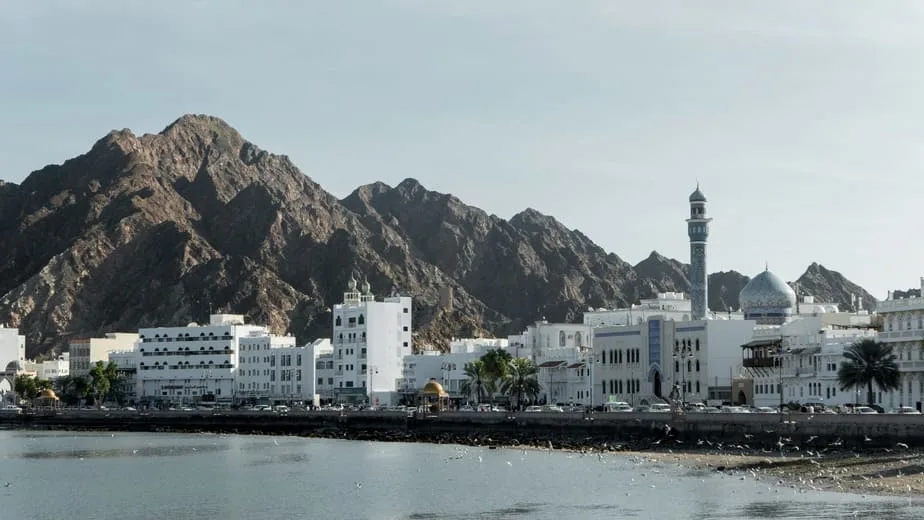
The Corniche directly outside is 3.5 kilometres of waterfront promenade. Walk it in the evening — the mountains behind Mutrah turn copper and the dhow harbour lights up. Don't walk it at noon. I mean it.
Al Alam Palace and the Twin Forts
Al Alam is the Sultan's ceremonial palace — you can't go inside, but the blue and gold facade framed by Jalali and Mirani forts on either side is one of Muscat's most photographed views. Most guides say "go in the morning." I disagree. The palace faces north, which means the facade is in flat shadow most of the morning. Come at 4:30 to 5:30 PM when the sun wraps around and the stone forts glow warm gold. The evening sea breeze is also a genuine improvement on the morning stillness. Entry to the palace grounds gate area is free.
Royal Opera House Muscat
Even if nothing is performing during your visit — and the season runs roughly October to April — the Royal Opera House is worth 30 to 45 minutes of your time. The architecture blends Omani Islamic design with Italian marble and is genuinely beautiful, not just impressive. Walk the courtyard, look up at the carved stonework, browse the small shops inside. Evening is when it comes alive. Check the schedule at rohmuscat.gov.om before you arrive; tickets for concerts range from about 5 to 40 OMR and sell out faster than you'd expect.
The Underrated Muscat Sights Locals Actually Love
These are the Muscat attractions that locals mention and visitors never find in their itinerary. Fix that.
Bait Al Zubair Museum in Old Muscat is my top recommendation for first-timers who want cultural context. Unlike the larger National Museum — which is impressive but can feel like a lecture — Bait Al Zubair is housed in a genuine historic residence with courtyard gardens, and its collection of weapons, jewellery, traditional dress and household objects feels personal and curated rather than encyclopedic. Entry is 2 OMR. Allow 90 minutes. It's a five-minute walk from Al Alam Palace, so combine them easily.
Muttrah Fish Market between 5:30 and 7:30 AM is the most viscerally alive place in Muscat at that hour. Fishermen bring in yellowfin tuna, kingfish, barracuda, hamour. Buyers and restaurant owners crowd the floor. It's loud, pungent, efficient, and completely absorbing. Wear closed shoes. Don't touch. Do bring a camera with low-light capability because the fluorescent lighting is merciless. By 8:00 AM it's essentially over.
Riyam Park at sunset gives you an elevated view over Mutrah Harbour and the mountains — the same view the Instagram accounts use but without the admission fee or the crowds. Families gather here in the late afternoon; it's genuinely local and genuinely lovely.
Al Mouj Marina is Muscat's modern waterfront neighbourhood, and an evening walk here — especially on a Thursday or Friday night — shows you a side of the city that's easy to miss if you only visit the historic areas. Good restaurants, a well-designed promenade, and a view of the marina that proves Muscat has contemporary style when it wants to.

Muscat Sightseeing by Neighborhood — A Local's Map
Muscat isn't one place. Understanding which neighbourhood holds what will save you a lot of confused driving and heat exposure.
Old Muscat (Al Alam area) is where the history is concentrated — the palace, the twin forts, Bait Al Zubair Museum, and the Portuguese-era sea gates. It's compact enough to walk between these specific sites, but you'll need a car to get there from most hotels. The area closes in on itself after 8:00 PM.
Mutrah sits just west of Old Muscat along the bay. The souq, the fish market, the Corniche, and Riyam Park are all here. This is Muscat's most atmospheric neighbourhood — layered, slightly chaotic, genuinely historic. Plan to spend the most time here.
Qurum is where many mid-range and business hotels sit, roughly 15 kilometres from Mutrah. Qurum Beach is pleasant for an early morning run but not a major sightseeing destination. The Natural Park in Qurum has an inlet that attracts birds — worth 45 minutes if that interests you.
Al Mouj and Ghubra are the newer, more affluent western neighbourhoods. Al Mouj Marina is the reason to visit. The Grand Mosque is in this general corridor too — technically it's in Al Ghubra, about 5 kilometres past the city centre toward the airport.
Madinat Al Sultan Qaboos (MQ) is a leafy residential and embassy district between Qurum and the mosque. The Royal Opera House is here. Quiet, upscale, worth an evening.

How Long Do You Actually Need for Muscat Sightseeing?
Honest answer: one very well-planned day covers the essentials. Two days lets you breathe. Three days means you can add a Wadi Shab day trip from Muscat — which, frankly, should be non-negotiable if you're here for more than 48 hours. The table below is how I actually advise people who message me.
| Time Available | What You Can Realistically See | Best Approach |
|---|---|---|
| Half day (4–5 hours) | Mosque + Mutrah Souq + Corniche | Private car essential |
| Full day (8 hours) | All main sights + 1 hidden gem | Private tour recommended |
| 2 days | Complete Muscat + day trip option | Mix of guided + free time |
| 3+ days | Deep dive including surroundings | Flexible private driver |
If you're working with more time and want structure, the Oman 5-day itinerary that OmanTour runs is genuinely well-paced — Muscat gets the first day properly, and the rest of the country opens up from there.

The Muscat Sightseeing Mistake That Ruins Day Trips
Timing. It is always timing. Let me be completely specific so you can't miss it.
The Grand Mosque closes to tourists at 11:00 AM Saturday through Thursday, and all day Friday. If you wake up at 8:30, have a hotel breakfast, and figure you'll head over around 10:00 — you have 45 minutes inside, maximum, and you'll spend 20 of them in the abaya-borrowing queue. Set your alarm. Be parked outside before 8:30 AM.
The Muttrah Fish Market is functionally over by 8:00 AM. The active buying period is 5:30 to 7:00 AM. Arrive at 7:45 and you'll find a few stragglers and a lot of ice. This is a pre-dawn decision, not a morning-stroll decision.
Between roughly 11:00 AM and 4:00 PM from May through September, being outside in Muscat is genuinely unpleasant — temperatures regularly hit 40 to 45°C with humidity. Plan indoor activities (Bait Al Zubair, the Opera House galleries, a long lunch) for the midday block. Save the Corniche, Riyam Park, and Old Muscat walking for after 4:30 PM.
Ramadan also changes everything — the mosque closes to tourists, souq hours shift to evening, and many restaurants are shuttered until iftar. It's not a bad time to visit, but you need to research the specific calendar year's dates in advance.

Getting Around Muscat for Sightseeing — Honest Options
Let me be direct about each option so you don't waste time figuring this out on arrival.
Walking: Only viable within specific neighbourhoods — Mutrah Souq to the Corniche, or Al Alam Palace to Bait Al Zubair. Between neighbourhoods? Not practical, not safe in summer heat, and the road infrastructure is genuinely not designed for pedestrians.
Taxis: Metered taxis exist but are inconsistent on the meter. You'll often negotiate a price, which requires knowing what's fair (Mutrah to the Grand Mosque should be roughly 3–4 OMR). Fine for one-off trips; frustrating for a full day of sightseeing where you want a car waiting.
Ride apps: Careem and OTaxi work in Muscat. Reliable in central areas, slower to respond in Old Muscat and Mutrah, and surge pricing applies during peak evening hours. Good for getting back to your hotel at night.
Private driver or guided tour: The genuinely right answer for sightseeing. A knowledgeable driver eliminates the parking problem (Old Muscat parking is chaotic), the timing problem, and the logistical problem of sequencing a day correctly. A Muscat private city tour means someone has already solved the itinerary so you don't arrive at a closed mosque at 11:15 AM with a hot, irritated family. After two years here, this is what I tell every single person who asks.

Muscat Sightseeing FAQ
What are the must-see sights in Muscat for first timers?
Sultan Qaboos Grand Mosque, Mutrah Souq and Corniche, Al Alam Palace with the twin forts, and Bait Al Zubair Museum together give you the full picture of Muscat — spiritual, mercantile, historical, and cultural. If you only have one day, hit these four in that order and you'll leave with a genuine understanding of the city.
How many days do I need for Muscat sightseeing?
One well-structured day covers the core attractions without rushing. Two days is ideal — it lets you add the underrated spots and enjoy evenings at the Opera House or Al Mouj Marina. Three days or more allows a day trip out to Wadi Shab or Nizwa.
What time does the Grand Mosque open for tourists?
Tourist visiting hours are 8:00 AM to 11:00 AM, Saturday through Thursday. The mosque is closed to non-Muslim visitors on Fridays. Arrive by 8:30 AM at the latest to have a relaxed, unhurried visit inside the prayer hall.
Is Muscat sightseeing safe for solo female travelers?
Muscat is one of the safest cities I have lived in, and I say that as a woman who walks alone here regularly. Street harassment is genuinely rare. Dress modestly outside of hotel pools and beach areas — shoulders and knees covered is the practical standard — and you'll have zero issues exploring any of the tourist areas alone, day or evening.
What is the best time of year for Muscat sightseeing?
October through March is the sweet spot — temperatures range from 20 to 30°C, evenings are pleasant, and you can walk the Corniche at midday without suffering. November and February are my personal favorites. April and May are manageable. June through September is genuinely brutal heat-wise and best avoided unless you're heat-tolerant and committed to early starts.
Can I do Muscat sightseeing without a car?
You can cover Mutrah on foot and use ride apps for isolated trips, but a cohesive sightseeing day without a car is genuinely difficult given the distances involved. For any visit with serious sightseeing ambition, a private driver or rental car is the practical answer — and the private driver option removes the parking headaches entirely.
The Honest Closing Recommendation
Muscat sightseeing rewards preparation more than almost any city I've visited. The sights are genuinely world-class — that mosque interior, those forts, that souq — but the city does not hold your hand with convenient proximity or forgiving hours. Get the timing right, have a car sorted, and resist the urge to cram everything into one sweltering afternoon. Start at the Grand Mosque before 9:00 AM, work east to Old Muscat by early afternoon, land in Mutrah for the golden-hour Corniche walk, and end somewhere with a view. That's the day.
If you'd rather hand the logistics to someone who already knows this city well, the team at OmanTour has put together private Muscat tours that sequence everything correctly — reach them directly on WhatsApp at +968 9468 1176 to ask about availability and custom options. No regrets about missing the fish market, no missed mosque, no taxi negotiations in the midday heat.
